
Pricing strategy · July 2026
Pricing power
Why the best companies charge more, not less.
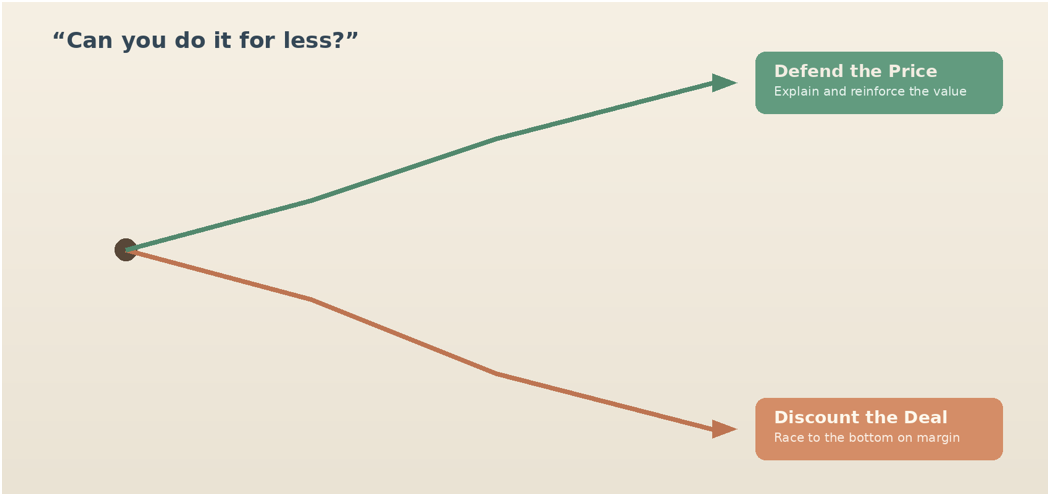
Two ways to answer the same question
Most business leaders know the moment: a promising customer asks, “Can you do it for less?” Some organisations begin negotiating immediately, layering in discounts, adjusted terms, and concessions until the deal is won at the cost of margin. Others defend their price, explain the value they create, and remain clear about why it matters.
That difference can look small in one transaction. Repeated over hundreds of deals, it can determine the profitability of an entire business. Two companies can generate the same revenue while creating radically different levels of profit: one works harder to recover thin margins through volume, while the other captures stronger returns because customers recognise the value it creates.
Pricing is not a tactical afterthought. It is one of the few business decisions that can improve profitability almost immediately.
Customers pay for perceived value
The luxury-goods industry makes this visible. Customers often choose brands with waiting lists and premium prices even when less expensive alternatives can perform the same practical task. They are paying for more than functionality: craftsmanship, heritage, exclusivity, quality, trust, and emotional connection.
Most companies price from the inside out—starting with cost, adding a margin, and comparing competitors. Pricing power is built from the outside in. It starts with how the customer perceives the value on offer. When that perception is strong, a customer is buying an experience, identity, or confidence in an outcome—not simply an item or service.
Every business has some pricing power
The lesson extends well beyond luxury brands. Consider two consulting firms with similar technical capabilities: one competes mainly on price, while the other earns higher fees through expertise, results, reputation, and trust. The same pattern appears in manufacturing, software, professional services, healthcare, and retail.
Customers weigh reliability, convenience, responsiveness, quality, risk reduction, expertise, and the overall experience alongside price. Businesses that reduce every conversation to cost can get trapped in a race to the bottom: margins shrink, weaker economics create more dependence on volume, and the company often attracts less loyal, more demanding customers.
The value-capture equation
Every business creates value. The strategic question is how much of that value it gets to retain. Companies with weak pricing power may create plenty of value yet capture only a small share of it. Companies with strong pricing power create real value and keep a larger share—and that difference compounds over time.
Leadership teams often devote significant attention to cost management and growth initiatives while giving pricing too little strategic attention. Yet an improvement in price reaches every transaction, while cost reductions usually affect only specific activities. Strong pricing is therefore a reflection of positioning, differentiation, customer trust, and brand strength—not simply a financial decision.
The question worth asking regularly is straightforward: are we competing on price because we have chosen to, or because we have not created enough value for customers to happily pay more?
Key learnings
- Separate revenue from pricing. Two businesses can post identical revenue with very different profit outcomes, so track pricing discipline and margin quality alongside top-line growth.
- Build perceived value deliberately. Trust, reputation, experience, craftsmanship, and reliability influence what customers are willing to pay.
- Do not assume customers buy on price alone. Reliability, convenience, expertise, responsiveness, and risk reduction can be stronger advantages.
- Defend the value before conceding a discount. Consider what margin and long-term positioning a concession gives away, then clarify the value behind the price.
- Treat pricing as a strategic capability. A small pricing improvement can move profitability across every transaction in the business.